How I work with AI
Spec first. Agents research, skeptic agents check, reviewers take one lens each, and a human says yes to anything irreversible.
1The loop
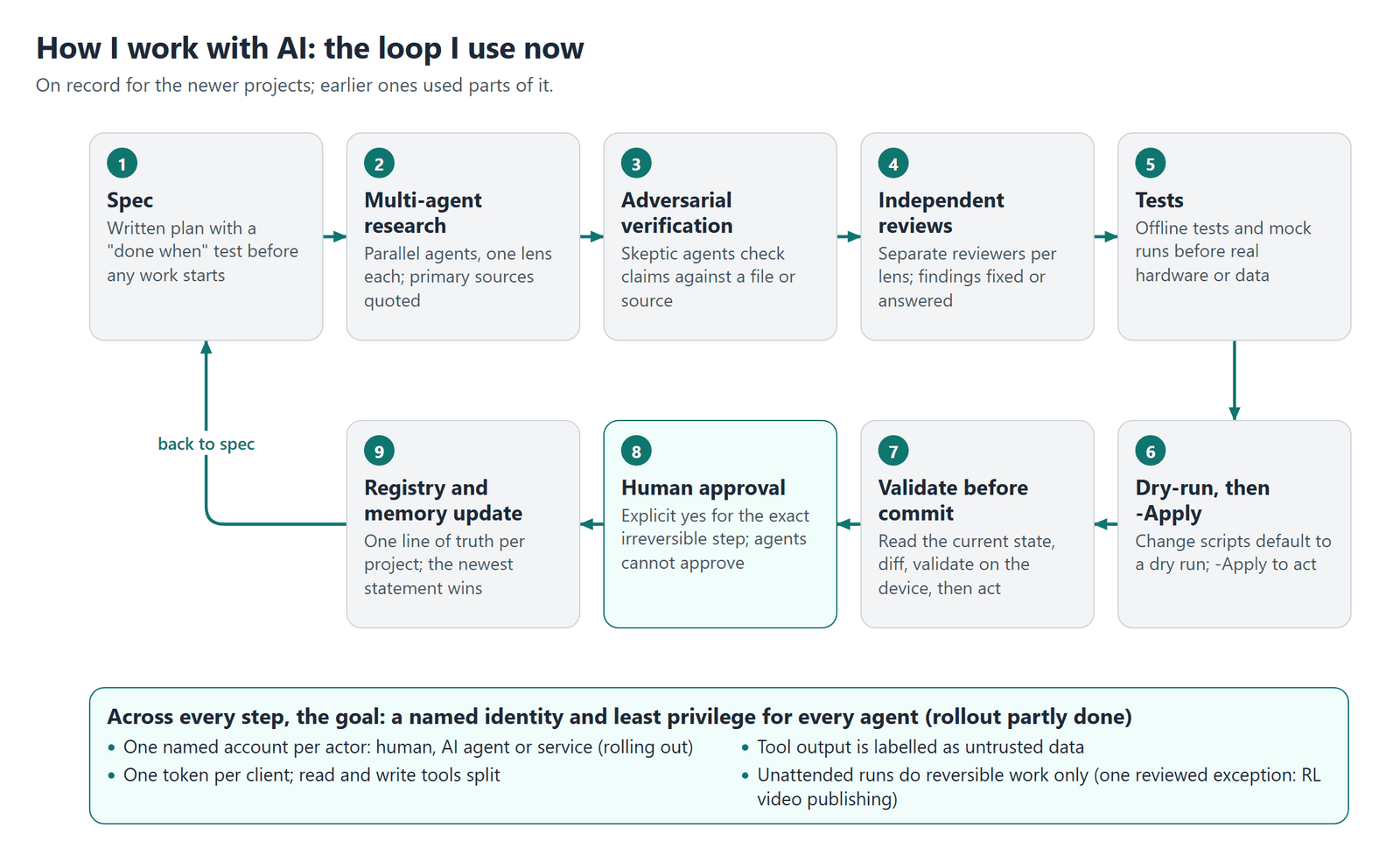
This loop is how I work now. The hub and the node script went through every step of it. The AI-zone design has been through the steps up to its own review. Earlier projects used parts of it.
I write the spec and its "done when" test. Agents research and quote primary sources. Skeptic agents check claims against a file or a source. Independent reviewers check one lens at a time. Then come offline tests, a dry run, and a human yes for anything irreversible.
My part is the spec, the decisions and the verification. Most of the code is AI-written.
2Guardrails for the agents I build
- One named account per actor: human, AI agent or service. This has been my rule since Oct 2026, and it is partly rolled out.
- One token per client, with read and write tools split.
- Tool output is labelled as untrusted data, not instructions.
- Unattended runs do reversible work only. The one exception is RL Recorder, which publishes videos on its own, but only in formats I have reviewed.
- Agents cannot approve their own risky steps.
- Most change scripts default to a dry run and need an explicit Apply switch.
3Where the checking paid off
| Case | Agents | Outcome |
|---|---|---|
| Checking another AI assistant's advice on local models | 5 researchers and 3 skeptics, primary sources only | 2 of its 4 model picks were stale or unsupported; its headline claim was backwards |
| Choosing the hub platform | 6 researchers, 8 skeptics and 5 local sweeps | n8n was checked before I built on it |
| Truing up my own docs | 10 auditors, then 10 skeptics | 403 findings: 267 confirmed, 132 corrected, 1 refuted, 3 downgraded; 80 missed items added; 364 edits applied |
| Work queue, before go-live | Race test: 12 rounds x 24 parallel claims | Caught a default match setting that let one agent overwrite another's held row; fixed, then one winner every round |
The truing-up result is the one I point to. The skeptics corrected, refuted or downgraded 136 of the 403 first-pass findings, about a third. They also added 80 that the auditors had missed. First-pass agent output needs a second, hostile read.