Hardware and architecture
All personal equipment, shown by role, with what is measured and where the sandbox move stands.
1The lab by role
All personal equipment, shown by role.
| Role | Hardware | What runs there |
|---|---|---|
| Desktop workstation | Ryzen 7 9800X3D, RTX 5090 (32 GB), 64 GB RAM | Claude Code, local general and router models, coordinator agent, video rendering |
| 128 GB AI node | AMD Ryzen AI Max+ 395 (Strix Halo), about 118 GiB GPU-addressable | 120B-class models, long and failover jobs, sandboxed agent |
| Laptop AI node | RTX 2070 Max-Q (8 GB) | Small router-class models, sandboxed agent |
| Lab server (Unraid) | 8-core CPU, no GPU | n8n, central logging, self-hosted search, file store |
| Lab firewall | PA-440 on PAN-OS 11.1 | AI zone designed, not committed |
| Overlay | Tailscale | Tailnet-first access; headless nodes managed over SSH |
| Small cloud VPS | Hosted | This site |
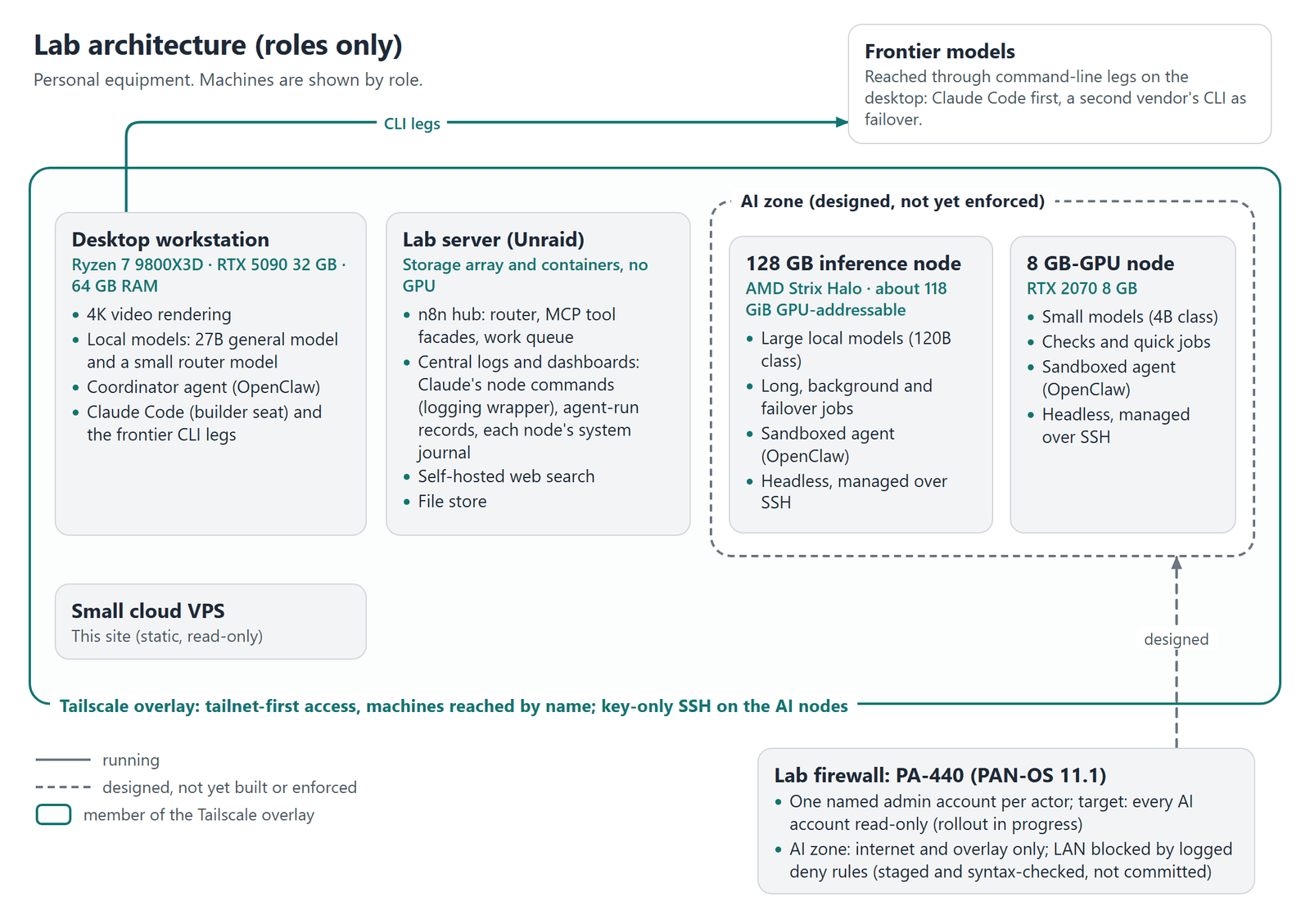
2Measured on the nodes
A 120B open-weight model (gpt-oss:120b) on the 128 GB node reads a 73,000-token prompt at about 200 tokens/s and writes at about 24 tokens/s at that depth, fully on the GPU. In a test job it passed a code task (20 of 20, plus 4 of 4 safety cases) but missed the bar on long-document extraction (recall 0.71 against 0.85) and scored 4 of 10 on a judgement memo.
A 4B router model on the 8 GB laptop GPU writes at about 64 tokens/s. I have no in-lab benchmark for the desktop GPU, so I quote none.
3Where the sandbox move stands
| Piece | State |
|---|---|
| Dedicated AI nodes | In place |
| Per-agent identities | Per-agent tokens on the hub and the node agents; the node agents run as their own unprivileged user; firewall accounts created, the four read-only AI logins pending; the desktop agents get their own identities when the desktop workloads move to the sandbox |
| Scoped MCP facades, one token per client | In place |
| AI firewall zone | Designed and staged, not committed |
| Desktop workloads | Still on the desktop: local models, the coordinator agent, CLI execution, video rendering |